
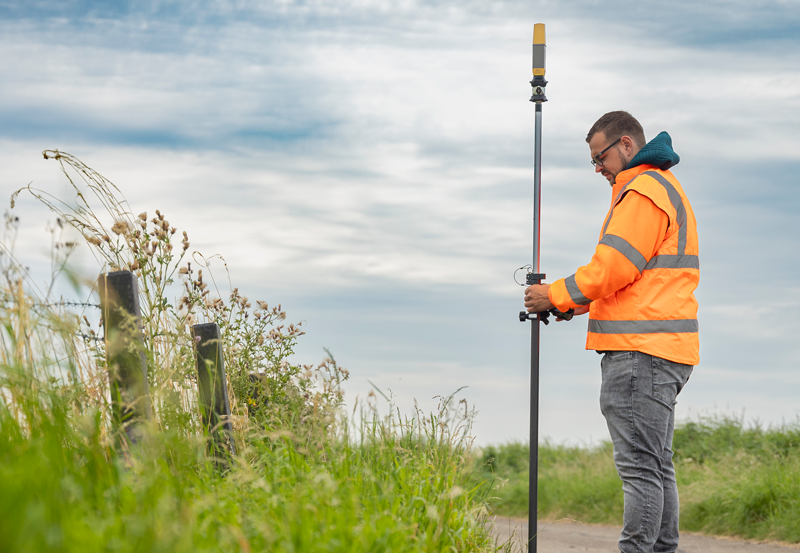
In the world of land surveying, where precision is everything, we often focus on the high-tech instruments like robotic total stations and sophisticated GNSS receivers. However, there’s a simpler, yet equally critical, piece of equipment that is the unsung hero of the job: the survey pole. Whether it’s a robotic prism pole used with a total station or a GNSS rover rod, its proper calibration is paramount for reliable and accurate results. Ignoring this small but mighty tool can introduce significant errors, undermining even the most advanced technology.
The importance of a calibrated pole boils down to one thing: eliminating systematic error. A systematic error is a consistent, repeatable error that affects every measurement in the same way. When a survey pole isn’t properly calibrated, it acts as a silent saboteur, systematically corrupting every data point you collect. Let’s break down the key reasons why this seemingly simple piece of equipment requires such meticulous attention.
Pole Height Accuracy: The Vertical Cornerstone
The first and most fundamental reason for calibration is pole height accuracy. A robotic total station measures the slope distance and angle to the prism, and uses the pole height to calculate the exact horizontal and vertical coordinates of the point on the ground. If the pole’s height is off—even by a couple of millimeters—that error is directly transferred to the elevation of every single point you measure. A 2 mm error in pole height translates to a 2 mm error in elevation. This might seem minor, but in construction and engineering, where tolerances are tight, this small oversight can lead to costly mistakes.
Prism Constant: The Distance Correction
Next is the prism constant, also known as the prism offset. Every prism has a specific optical center that doesn’t align perfectly with its physical center. The prism constant is a correction factor that accounts for this difference. This value must be accurately entered into the total station’s software. A mismatch between the prism’s true constant and the value set in the instrument will introduce a constant error into all your distance measurements. This can range from a few millimeters to several centimeters, potentially throwing off an entire project.
Straightness and Bubble Calibration: The Tilt Trap
Another critical factor is the pole’s straightness and the calibration of its bubble. The bubble level on a survey pole ensures that the prism or GNSS antenna is positioned precisely and vertically above the survey point. A miscalibrated bubble, or a slight bend in the pole, can cause the pole to tilt. Even a small tilt can introduce a horizontal error. For example, a 2-meter pole that’s just 10 mm off-center at the top can create a horizontal error of about 5 mm at the base. This is a common source of horizontal inaccuracies, especially in control surveys where precise point placement is essential.
Calibrated Pole Consistency and Best Practices
Ultimately, regular calibration ensures consistency across all surveys and among all survey crews. Without it, systematic errors can accumulate, compromising control networks, traverse closures, and construction layouts. A team might use the same advanced instruments, but if their poles aren’t checked, their measurements won’t be interchangeable or reliable.
To maintain this vital accuracy, a few simple best practices are a must. Always check the calibrated pole bubble regularly—daily is a good habit. Verify that the pole height markings are accurate, and if your pole is adjustable, ensure the locking mechanisms are secure. Confirm that the prism constant in your instrument matches the manufacturer’s specification. Finally, if the pole has been dropped or handled roughly, recheck its calibration immediately. By paying attention to this fundamental piece of equipment, you ensure that every point you measure is built on a foundation of accuracy, allowing you to trust your data and the project it supports.