
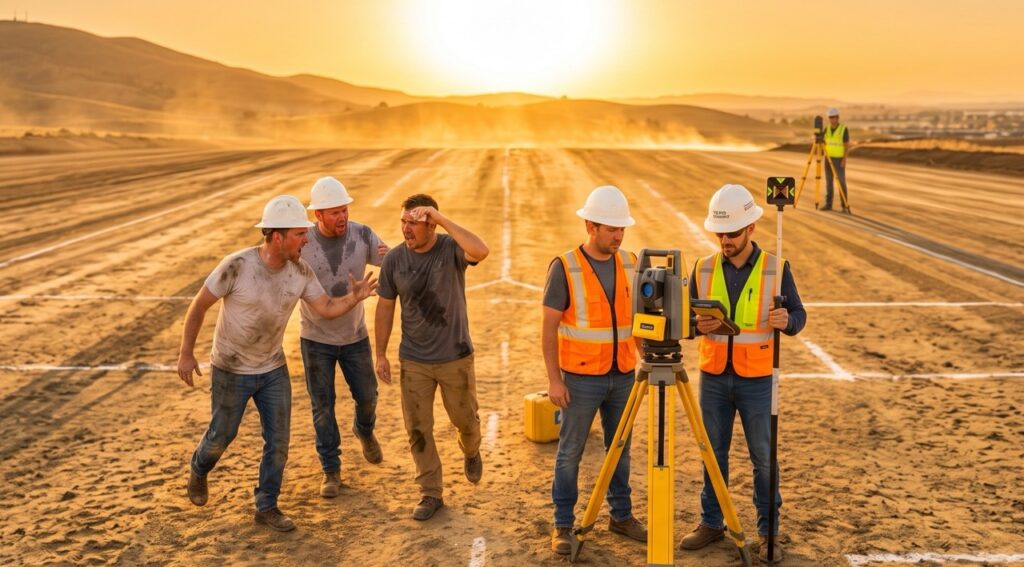
It’s June. The Southern California sun is beating down, daylight hours are at their absolute peak, and your project pipeline is completely full. In a perfect world, this is exactly where your firm wants to be.
In the real world, you are staring at a massive scheduling board, trying to figure out how to stretch three active survey crews across five different high-priority commercial, residential, and infrastructure jobsites.
The summer construction crunch is officially here. It’s a relentless season where missing a single milestone can trigger a cascading domino effect of project delays, unhappy contractors, and liquidated damages. Yet, year after year, survey managers face the exact same bottleneck: a severe shortage of skilled field crews. Finding experienced party chiefs and rodmen who can step onto a jobsite and produce error-free work immediately feels nearly impossible.
If your crews are stretched thin, running your field operations ragged isn’t the solution. The answer lies in shifting your workflow from labor-heavy to technology-optimized.
Investing in a Robotic Total Station (RTS) is the single most effective way to solve the summer labor crunch. Transitioning from a traditional two-person crew to a robotic layout workflow can immediately double your field efficiency, keep projects on schedule, and protect your bottom line.
The Reality of the Summer Surveying Bottleneck
The mathematics of traditional surveying during peak season simply don’t add up anymore. A standard mechanical total station setup dictates a hard operational rule: it requires two people. 1. The Instrument Operator: Sits behind the gun, manually sighting the target, turning angles, and tracking data. 2. The Rodman/Prism Bearer: Moves across the site, physically holding the prism pole over the points to be staked or collected.
When you are short-staffed, this two-person dependency paralyzes your growth. If one crew member calls out sick on a Tuesday in July, that entire truck sits idle. The instrument operator can’t run the gun and hold the rod simultaneously. A two-person dependency means your capacity is strictly capped by your headcount.
Furthermore, summer conditions amplify human error. Fatigue sets in rapidly when field crews work long hours in 90°F+ heat. Communication breakdowns—whether due to ambient jobsite noise, wind, or simple exhaustion—lead to misread numbers, misplaced stakes, and missed shots. When a two-person crew has to constantly shout back and forth or rely on hand signals over a chaotic jobsite, mistakes happen. In surveying, a mistake caught late means a costly revisit to the site or, worse, an incorrect concrete pour.
How Robotic Total Stations Redefine Field Efficiency
A Robotic Total Station completely flips this script by automating the instrument side of the equation. Equipped with advanced motorized drives, automatic target recognition, and remote radio tracking, the RTS handles the heavy lifting of sighting and tracking entirely on its own.
By putting the data collector directly into the hands of the person standing at the point, you unlock three massive operational advantages:
1. The Power of the One-Person Crew
The most immediate relief to your labor shortage is the ability to deploy one-person crews. Because the RTS automatically locks onto and tracks the prism, the party chief can run the entire operation solo from the prism pole.
Suddenly, your workforce math changes. If you have four skilled field surveyors, they no longer have to be paired up into two crews. Armed with robotic total stations, you can split them into four independent, highly mobile units. You have just instantly doubled your field capacity without hiring a single additional employee.
2. Complete Control at the Point of Lay Out
In a traditional setup, the person making the critical decisions (the party chief) is often stuck behind the gun, relying on the rodman to properly interpret instructions at the actual stake location.
With a robotic system, your most experienced surveyor is the one holding the pole and the data collector. They are looking directly at the design blueprint on their screen, standing precisely where the work is happening. They can instantly see cut/fill values, make real-time decisions on obstacles, and verify data accuracy on the spot without a game of telephone across the jobsite.
3. Unmatched Speed and Precision
Robotic instruments don’t get tired, blink, or lose focus in the afternoon glare. Modern systems lock onto the prism instantly and track it smoothly, even through heavy jobsite traffic or brief obstructions. Staking out points becomes a continuous, fluid walk rather than a stop-and-go process of manual sighting. A single surveyor using an RTS can often stake out twice as many points in a single day compared to a traditional two-person crew.
Calculating the ROI: It Pays for Itself Faster Than You Think
The primary hurdle for many surveying and construction firms is the initial upfront cost of upgrading to robotic technology. It’s easy to look at the price tag of a premium robotic total station and hesitate. However, when viewed through the lens of labor savings and increased productivity, the return on investment (ROI) is staggering.
Let’s look at a conservative real-world scenario:
| Expense Category | Traditional Two-Person Crew | Robotic One-Person Crew |
| Daily Labor Cost (Avg. fully burdened wages) | $600 – $800 / day | $300 – $400 / day |
| Staking Speed | Base rate | ~1.5x to 2x faster |
| Monthly Field Capacity | Fixed by headcount | Doubled (by splitting crews) |
By transitioning to a robotic workflow, you are saving hundreds of dollars per day in raw labor costs on a single crew. Over a standard 20-day working month, a single robotic unit can save your business thousands in field overhead alone.
When you factor in the elimination of costly layout errors, the ability to take on more summer contracts, and the reduction in vehicle/fuel expenses (by sending one person to a site instead of two), a premium robotic total station typically pays for itself entirely within 6 to 9 months. Everything after that is pure profit injected back into your business.
Choosing the Right Tech Partner for Peak Season
Investing in a robotic total station is about more than just buying a piece of hardware—it’s about choosing a robust ecosystem that integrates seamlessly into your current daily workflows.
When you’re fighting the summer clock, you cannot afford to waste weeks trying to figure out complicated software or dealing with hardware that feels disconnected from your field crew’s realities. Look for systems that offer:
- Advanced Prism Tracking: Crucial for maintaining a reliable lock on active, chaotic construction sites with moving vehicles and dust.
- Intuitive Field Software: Look for field software that simplifies complex 3D data collection and layout tasks into clear, visual, step-by-step instructions.
- Hybrid Compatibility: The ability to seamlessly pair your RTS with GNSS receivers so your solo operator can switch between satellite positioning and optical precision with a single button press.
Most importantly, you need a local technology partner who provides comprehensive training and immediate technical support. If a field crew encounters a software snag or a calibration question at 7:00 AM on a Friday, they don’t have time to wait for an overseas customer service department to reply. You need a dedicated team that can troubleshoot your equipment immediately, offer rapid local calibration turnarounds, or supply a loaner unit to keep your project moving forward without missing a beat.
Don’t Let the Summer Crunch Slow Your Business Down
The summer labor shortage doesn’t have to mean turned-down contracts, exhausted crews, or missed deadlines. By empowering your team with robotic total stations, you can optimize your current workforce, significantly reduce human error, and supercharge your daily field productivity.
Stop trying to solve a 21st-century labor problem with outdated, labor-heavy field methods. Let technology take the strain off your team so you can focus on scaling your business.
Ready to see what a one-person robotic workflow can do for your crew? > Choosing the right precision gear isn’t a one-size-fits-all decision.
Fill out our quick form to Schedule a Hands-On, On-Site Demo at your jobsite or visit one of our convenient Southern California locations today. Let our expert Topo Element team get your crew dialed in, productive, and ready to dominate this summer.