
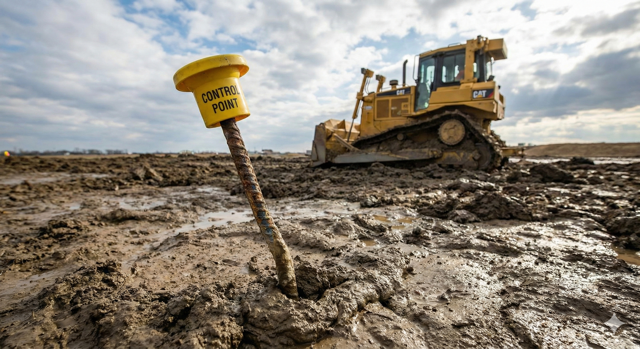
The rainy season in California this winter has been intense. Your site has likely spent the last few months alternating between being a shallow lake and a mud pit.
Now, the breaks in the clouds are getting longer. The ground is starting to firm up. The pressure from developers and owners to make up for lost time is mounting, and you are ready to mobilize the heavy equipment and get vertical.
But before you trust your layout to the stakes and hubs that have weathered the winter, you need to ask a critical question: Did the site move?
Proceeding into the spring building season without re-verifying your primary control network is a massive gamble—one that often results in expensive rework and blown schedules.
How Winter Destroys Site Control
Survey control points—the fundamental anchors bridging the design plans to the physical reality of your dirt—feel permanent when they are set in dry ground in October.
But a wet winter changes everything. Here is what has likely happened to your control network over the last four months:
- Hydrostatic Pressure and Soil Heave: Oversaturated soil swells and shifts. Clay-heavy soils, common in our region, expand significantly when wet. This subterranean movement can easily shift a “permanent” rebar several inches horizontally or vertically.
- Erosion and Sediment: Heavy runoff may have completely washed out some control points or buried others under feet of sediment, making them impossible to find or unreliable if found.
- Heavy Machinery in the Mud: This is the most common culprit. When dozers, scrapers, and excavators are sliding around in the muck, they run over lathes and bump hubs. In deep mud, an operator often has no idea they just clipped a critical control point.
The High Cost of a “Minor” Shift
A two-inch shift in a primary control point might not seem like much in a ten-acre muddy field.
However, construction errors are compound. If your primary control is off by two inches, every subsequent layout based on that point is wrong. Foundation bolts miss steel columns. Utility stub-ups end up in the middle of hallways. Prefabricated wall panels don’t align.
The mistake is rarely caught during rough grading. It’s caught when the concrete trucks are lined up or when steel is swinging from a crane. At that point, the cost to fix it involves jackhammers, change orders, and weeks of delay.
The Solution: A Quick “Health Check” for Your Site
The good news is that you don’t need to redo the entire boundary survey. You just need verification.
Before you begin major layout for foundations or utilities this spring, come to Topo Element for a site control verification.
High-precision total stations will locate your existing primary control points and check them against known, stable off-site benchmarks and the original project coordinate system. You can quickly identify which points are holding fast, which ones have shifted beyond tolerance, and which ones need to be reset entirely.
Cheap Insurance
Think of a control verification survey as a cheap insurance policy against a catastrophic construction error. It’s a small investment of time right now that ensures the frenetic pace of the spring build doesn’t grind to a halt later because the building is in the wrong spot.
The mud is drying. Get ready to build, but verify your foundation first.
Contact Topo Element today to schedule a service or demo.