
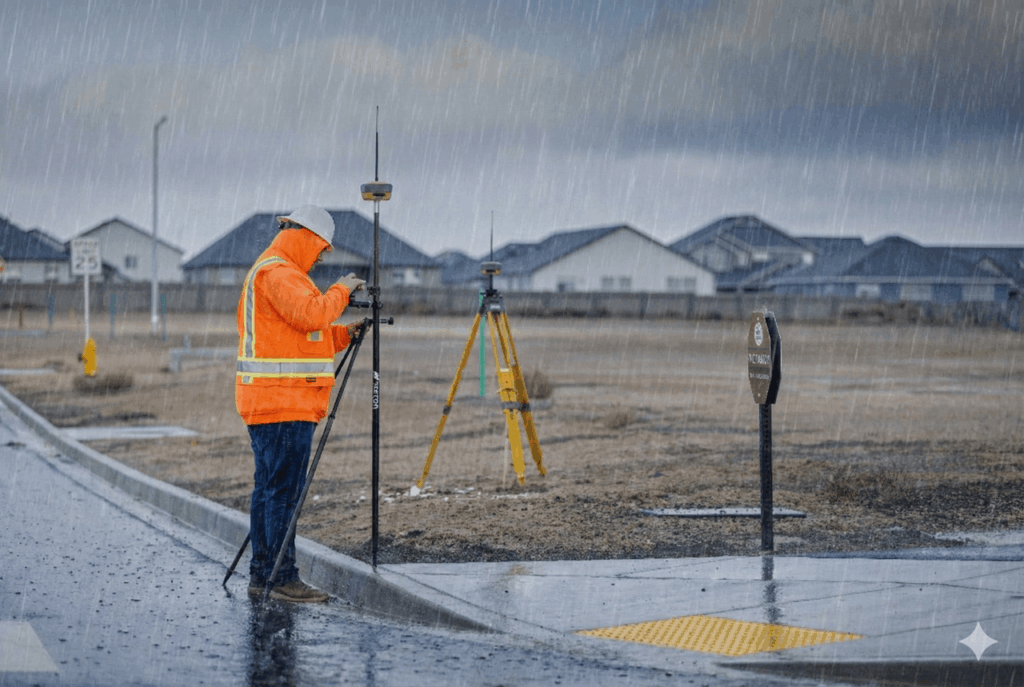
Southern California might not get blizzards, but veteran surveyors know that the winter brings its own set of challenges. We get rain, persistent marine layers, and chilly mornings that can drop into the 30s and 40s.
While you might just need an extra jacket, your precision surveying equipment—particularly total stations, robotic instruments, and GNSS receivers—is highly sensitive to these environmental shifts. A modern robotic total station is essentially a high-end computer fused with delicate optics. When you mix electronics, glass, and moisture, you have a recipe for expensive downtime.
Keeping your crews working efficiently through the winter means adopting a “winter workflow” for equipment care. A few extra minutes of preventative maintenance at the start and end of the day can save you thousands in repair costs later.
Here is how to protect your investment during the wetter months.
1. Battery Discipline: Beat the Voltage Drop
You have likely noticed that your smartphone battery dies faster on a cold day. Your survey gear is no different.
Lithium-ion batteries rely on chemical reactions to generate power. Cold temperatures slow these reactions down, increasing internal resistance and causing the voltage to drop faster than usual. A battery that showed a 100% charge in the office the night before might suddenly read 70% once it sits on a tripod in 45-degree weather for twenty minutes.
The Winter Workflow:
-
- Don’t leave them in the truck overnight: If temperatures are dropping, bring your data collector, instrument, and spare batteries indoors.
-
- Body heat is your friend: On really cold mornings, crew chiefs should keep spare batteries in an interior jacket pocket rather than in a cold backpack or instrument case. Keeping the spare warm means it will be ready to deliver full voltage when you swap it in.
2. The Cardinal Sin: The “Wet Case” Mistake
This is the single most common cause of winter equipment damage we see in our service center.
It starts raining in the middle of a Topo shoot. The crew rushes to pack up. They wipe the exterior of the total station quickly with a rag, put the damp instrument into its hard case, latch it shut, and throw it in the truck.
Do not do this.
The foam lining inside your instrument case acts like a sponge. If you put a wet instrument into a sealed case, the moisture has nowhere to go. As the truck warms up, that trapped moisture turns into a high-humidity steam room inside the case. This forces moisture deep into the internal electronics and behind the lenses, leading to corrosion and mold that can ruin the instrument.
The Winter Workflow: When you get back to the office or shop after a wet day, take the instrument out of the case. Wipe it down gently. Leave the instrument sitting out on a desk, and leave the hard case open so both can air-dry completely overnight in a controlled environment before packing it away again.
3. Fighting the Fog: Acclimation is Key
There is nothing more frustrating than setting up on a chilly morning, looking through the scope, and seeing nothing but gray fog.
Condensation happens when warm, moist air hits a cold surface. If your instrument sat in a 70-degree truck cab on the drive to the site, and you suddenly pull it out into 40-degree damp air, the lenses (and internal prisms) will instantly fog up.
The Winter Workflow: Patience is required. When you arrive at a cold job site, leave the instrument in its closed case outside the truck for 10–15 minutes before setting it up. This allows the glass and metal inside the case to slowly adjust to the ambient outside temperature, significantly reducing thermal shock and fogging when you finally open it up.
When in Doubt, Get it Calibrated
Following these steps will keep your gear running longer. However, if your EDM seems sluggish after a rainstorm, or you notice persistent internal fogging that won’t clear up, don’t force it.
Moisture damage is progressive. Bring it into Topo Element for an inspection. Our service technicians can properly dry, clean, and recalibrate your optics to ensure you are ready for the busy year ahead.